Ask a skeptic of AI-driven online education what worries them most, and the answer usually circles back to the same fear: more artificial intelligence in the classroom means less human connection. Online degrees already carry a reputation for isolation. Add AI to the mix, the thinking goes, and a student could complete an entire program without a meaningful exchange with another person.
San Francisco Bay University built its SFBU MBA Pro+ around a different premise. Rather than treating AI as a stand-in for the human elements of a degree, the program is organized around what its designers call “co-intelligence,” a working partnership between student, faculty and AI in which each does what it does best.
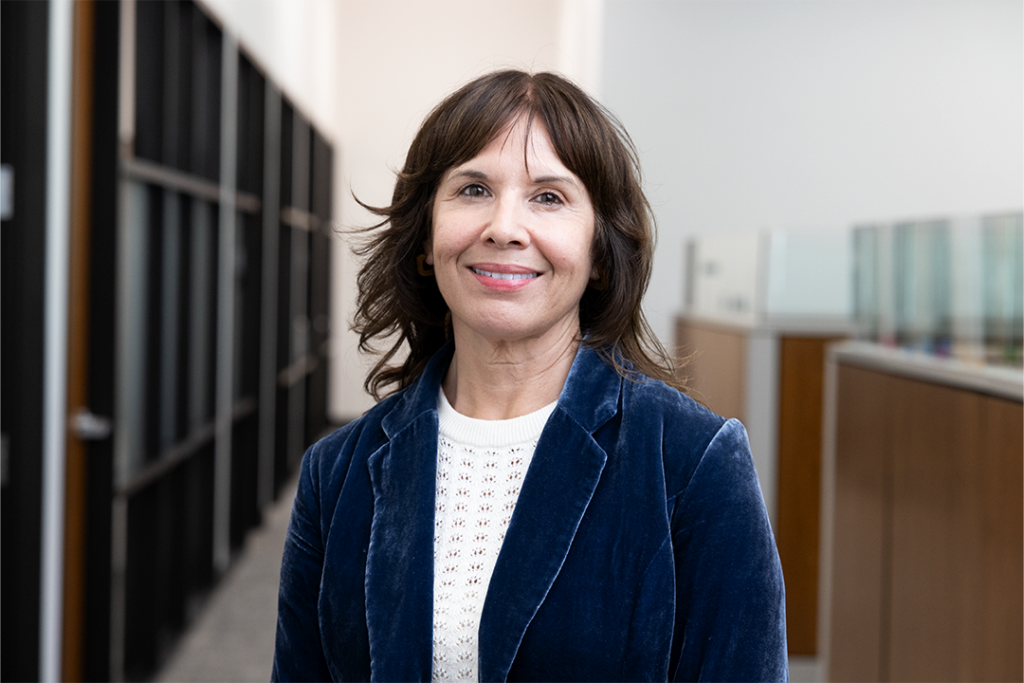
To understand how that idea moves from concept to classroom, we spoke with Heather Herrera, Ph.D., SFBU’s vice president of strategy and innovation and one of the architects of the MBA Pro+. Herrera spent two decades teaching before moving into higher education administration, and her answers reflect both vantage points: the practitioner weighing what actually helps students learn and the strategist deciding where AI belongs in a business degree, and where it doesn’t.
That strategist’s instinct is also shaped by geography. SFBU sits in Fremont, California, in the heart of Silicon Valley. Herrera says the university’s MBA Pro+ faculty regularly draw on that proximity, bringing in guest speakers from companies like NVIDIA and IBM and running hackathons with corporate sponsors. It’s an environment where questions about AI and higher education aren’t abstract.
Learn With AI as Your Personal Tutor
Practice Real-World Skills With AI Feedback
Built on Research: What Employers and Students Really Value
Herrera’s broader philosophy on the MBA Pro+ traces back to research SFBU conducted while designing its undergraduate curriculum, asking students, families and employers what they valued most. “Two themes came up repeatedly: relevance and agility,” she says. “People want to spend their time learning things that have relevance to them.”
The employer research surprised her. “Employers were indifferent about your degree or your grades,” she says. “They just wanted to know: Do you have a growth mindset? Do you have resiliency? Can you be upskilled?”
That finding “informed how we approached building a new online master’s program,” Herrera says. “The idea was to move away from being tied to old ways of thinking about degrees, which are tied to content delivery.”
Co-Intelligence: Rethinking the AI-Student Partnership
Herrera traces the term ‘co-intelligence’ to the work of researcher Ethan Mollick, “which looks at how we’re moving into a world where everything is co-created with AI,” she says.
In the MBA Pro+, that principle operates across multiple levels. Students engage interactively with the coursework while embedded AI tracks their progress. “It adjusts to the learner as the learner moves through the program,” Herrera says. “The intelligence is that the AI enhancements know the entire curriculum.”
A third layer involves the design of the degree itself, which leveraged AI tools during development to map dynamic learning pathways and continuously align coursework with employer-demanded skills. Taken together, Herrera says, the concept comes down to a balance of “the human insights, the human judgment, and the human experience combined with the AI technology.”
The ‘Living Curriculum’: Real-Time Updates in the Classroom
That same principle shapes what Herrera considers the program’s most distinctive feature. “The most exciting feature could be this idea of it being a living curriculum,” she says. “I’ve yet to see anything like that.”
Traditional online courses, once built, tend to stay fixed for years, because updating them has historically been slow and expensive. The MBA Pro+ was designed to work around that constraint. “If Apple announces that there’s a new CEO and a case study is pushed out, we can have that embedded in the course almost instantly,” Herrera says. Having spent her career in higher education, she says the pace of change is unlike anything she’s encountered. “I’ve worked in higher education my entire career. I’ve never been able to move the needle this quickly,” she says.
AI as a Coach, Not a Knowledge Shortcut
Herrera draws a sharp line between the AI a student might use independently, such as a chatbot pulled up to generate an answer, and the AI built into the MBA Pro+. “If a student is in a traditional class and getting answers from an enterprise platform like ChatGPT and then cutting and pasting, there’s no co-construction of knowledge happening there,” she says.
In the Pro+ program, students first engage with course material, then work through it with an AI that questions their understanding and adjusts based on how they respond. It functions less like an answer key and more like a tutor. “It’s the difference between just feeding you an answer and coaching you,” Herrera says.
That distinction matters because of what happens after graduation. “At the end of the day, in reality, when you are in the workforce, you can’t just put your boss on pause and turn to a platform and get an answer,” she says. “You do need to be able to articulate what you understand about something.”
‘Relational Architecture’: Designing Human Connection Into Distance Learning
For all the technology built into the MBA Pro+, Herrera says its designers assumed from the start that AI in education would draw skepticism, and treated human connection as a deliberate counterweight rather than an afterthought. “We anticipated that there would be backlash around AI,” she says. “We wanted to over-index on the human-centered design so that we weren’t offloading human judgment or human relationships to the AI. We’re very discreet and selective in how we deploy the AI technology.”
That design choice responds to a pattern Herrera has observed across online education generally. “We know that in online programs, often the social fabric is not even an afterthought,” she says. “It’s just not considered. And what is happening as a result is more social isolation.”
To counter that, SFBU built what Herrera calls “relational architecture” directly into the coursework: peer collaboration, mentorship touchpoints, live events and deliverables that require students to build real relationships outside the platform. “There are opportunities to learn with your peers,” she says. “There are mentorship opportunities. There are live events that happen.” One assignment sends students out to conduct customer discovery in person. “That is something where you actually have to go out and talk to potential customers and do real customer discovery and upload an artifact showing what that looked like,” she says.
The goal, Herrera says, extends beyond the degree itself: “One of the things that we’re really focused on is how do you build up your community cultural wealth and leverage that to advance your mastery and career.”
The AI feedback loop underwent similarly careful calibration, precisely because the aim is to build confidence rather than dependence. “We have spent thousands of hours vetting how the AI works to see that we’ve got it calibrated right to a place where it’s giving you the right feedback,” Herrera says. “It’s not just giving you answers; it’s stretching your thinking and helping you build competency and confidence in what you’re capable of doing.”
EdTech Strategy: Separating True Disruption From Fads
As vice president of strategy and innovation, part of Herrera’s job is separating genuine shifts in higher education from passing fads pitched by vendors. She says the difference comes down to one factor: “The big difference between a trend and a disruptor is scale.”
AI, in her view, qualifies as disruption. “Everybody has access to this, and it’s going to change how faculty work, how students learn,” she says. “It will change governance, and it will change policy. It will have wide-reaching impact.” A trend, by contrast, is easier to spot: “A trend can be a procurement decision. It’s not a strategic move. A trend could be buying an AR or VR headset. But that’s not going to materially change the institution or how you do things.”
Accessible Without Compromise: Flexible, $10K Higher Ed
High quality and affordability are often treated as mutually exclusive, but SFBU designed the MBA Pro+ to bridge that gap. “One of the features of the MBA Pro+ is the idea that it’s accessible without compromise,” she says. “We believe strongly in providing people with a quality education that is affordable.”
The numbers back up the claim. Total tuition for the MBA Pro+ is $10,000, billed course by course rather than as a lump sum, and students in the first three cohorts qualify for a scholarship. The program’s 12 courses can be taken one at a time, or two simultaneously (after finishing the fourth course), on a monthly start schedule. “The program is designed to be flexible,” Herrera says.
That flexibility, she says, is meant to remove obstacles that keep working professionals from starting at all. “Students don’t have to decide six months from now, or next semester, I’m going to start this degree,” she says. “If it works for you to start next month, then you can start next month. We try to minimize any barriers to entry.”
For Herrera, the wager behind the MBA Pro+ is that AI and human connection don’t have to compete, provided the program is built carefully enough to keep them working together. Prospective students can explore the SFBU MBA Pro+ learning experience or review tuition and admissions details for SFBU’s upcoming cohorts.
Ready to explore the future of business education? Speak with an enrollment advisor to ask questions about the curriculum, or begin your application for SFBU’s next monthly start.